Sustainability Across Cultures
Reflecting on three years of learning, cultural exchange and connection through NC State’s German Fulbright Sustainability Program.

Last summer, NC State’s Global Training Initiative (GTI) hosted its third and final cohort of German Fulbright students as part of a monthlong sustainability program. The program’s purpose was to help students learn about the role culture plays in sustainability, guided by the United Nations Sustainable Development Goals. Alongside classroom instruction, students gained cultural insights through their immersion in American life during their time at NC State.
The program began with a short stay in Washington, D.C., before participants arrived in Raleigh for the remainder of their experience. Despite the brevity of their stay, however, students dove headfirst into American and North Carolinian culture — from late-night Waffle House runs to braving the heat for Packapalooza.

For Vivien, a 20-year-old German student studying green technology management, the program offered an opportunity to explore the intersection of sustainability and culture while experiencing a different educational system. One of her most memorable moments came from a lecture that helped her see her own academic interests in a new light.
“It was a lecture that told me there’s room for my interests.”
The lecture focused on marine engineering, a field that connected several of her interests in technology and the ocean. Before the program, she hadn’t realized there was a name for the combination of subjects that interested her. Discovering that connection helped her recognize new possibilities for her future.

Learning Sustainability Through Different Perspectives
Sustainability was the common thread connecting the program’s participants, but they approached the subject from a variety of academic backgrounds.
Vivien described herself as someone who approaches sustainability from a technical perspective. Other participants came from a diverse range of academic fields, bringing different questions and priorities to their shared work.
“It was a very, very huge mix and very interesting,” Vivien said. “Things I never thought about because I’m so deep in the topic.”

Working alongside students from other disciplines challenged participants to look beyond their familiar approaches to sustainability. Technical knowledge remained important, but conversations with peers helped broaden their understanding of the social, cultural and practical dimensions of environmental challenges.
The program reinforced this interdisciplinary approach through a combination of lectures, research projects and hands-on experiences. Participants visited local farms, observed conservation efforts and explored North Carolina beaches, connecting academic concepts with the people and places involved in sustainability work.
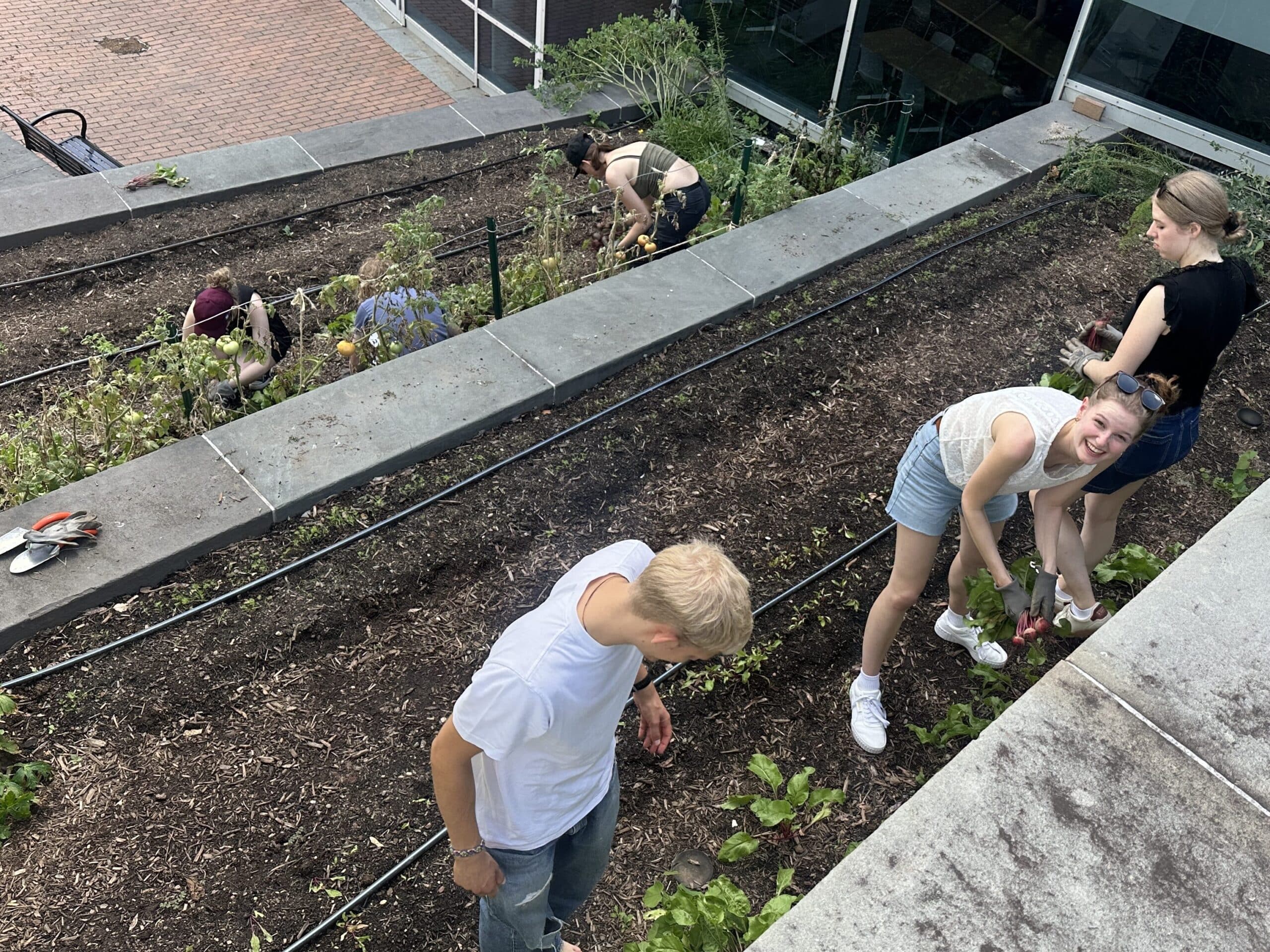
Nikolai Kutch, an NC State senior majoring in international studies with a concentration in Europe and minors in German and political science, interacted with participants during the program’s final two cohorts. Having studied in Germany himself through the Congress-Bundestag Youth Exchange program before coming to NC State, Kutch understood some of the challenges and opportunities that come with experiencing another country.
“The hands-on experience of visiting Howling Cow dairy farm or going to the beach or going to visit a farm or picking up trash … those are experiences that really require you to get out of the campus and go to where the people are who are doing these things,” Kutch said.
Kutch observed that the program offered something students could not necessarily get from a traditional classroom. Rather than simply studying sustainability as an academic subject, participants visited places where people were putting ideas into practice, then returned to campus to discuss what they had learned.

A Three-Year Partnership With a Lasting Impact
NC State’s partnership with the Fulbright Germany Sustainability Camp began in 2024, when the university welcomed its first cohort of 30 students. The program continued in 2025 and 2026, bringing a new group of students to campus each summer.
Funded by Fulbright Germany, the program connected students in applied sciences with NC State’s expertise in sustainability and its broader university community. Through GTI, participants engaged with faculty, explored local sustainability initiatives and experienced American culture beyond the classroom.

Heidi Hobbs, who contributed sessions on research posters and presentations, highlighted the importance of that approach.
“The emphasis on sustainability permeates the program and that truly makes it special.”
Hobbs also pointed to the students’ projects and hands-on experiences as evidence of the program’s educational value, describing it as a strong model for other Fulbright commissions interested in sending students to NC State.

Although the 2026 cohort marked the program’s final year at NC State, its conclusion does not diminish the connections established through three summers of collaboration. Instead, the experience offers a model for future international programs that bring together sustainability education, hands-on learning and cultural exchange.
Making Room for New Perspectives
For students considering an international program, the prospect of traveling to another country and entering an unfamiliar academic or cultural environment can feel intimidating. Vivien’s advice to students who may feel apprehensive is simple: Give it a chance. Although time from home might initially seem impossible, the experience passes quickly.

As NC State reflects on the conclusion of the Fulbright Germany Sustainability Camp, these experiences capture much of what made the program meaningful. Sustainability requires technical knowledge, but it also depends on the ability to consider different perspectives, engage with communities and remain open to new approaches.
Over three summers, the program brought those principles together through international collaboration, hands-on learning and the everyday experiences that turn unfamiliar places into meaningful connections.
- Categories: